Launch offer — valid today only

📄 Digital book in PDF · read it on your phone or print it

Kitchen Extract Cleaning in Drawings: Survey, Measure, Clean and Certify to the TR19 Grease Guidance The Same Order on Every Job

Canopy and plenum, grease filters, ductwork and risers, the pre-clean survey, comb gauge readings, safe isolation, cleaning methods, fire dampers and the post-clean report. Each topic has its own page: the drawing first, then what you need to remember. 67 illustrated pages.

GET THE ILLUSTRATED BOOK

🔒 Secure checkout · PDF by email · 30-day guarantee

Every topic, its own pageEach step of the job drawn, with the explanation alongside
67 illustrated pages8 parts, from why grease in a duct is a fire risk to your pre-course self-check
Up-to-date sourcesTR19 Grease guidance, HSE guidance and UK safety regulations
PDF by emailFormat

Look Inside the Book

Every page has one large drawing and a box with the numbers and steps you need to know:

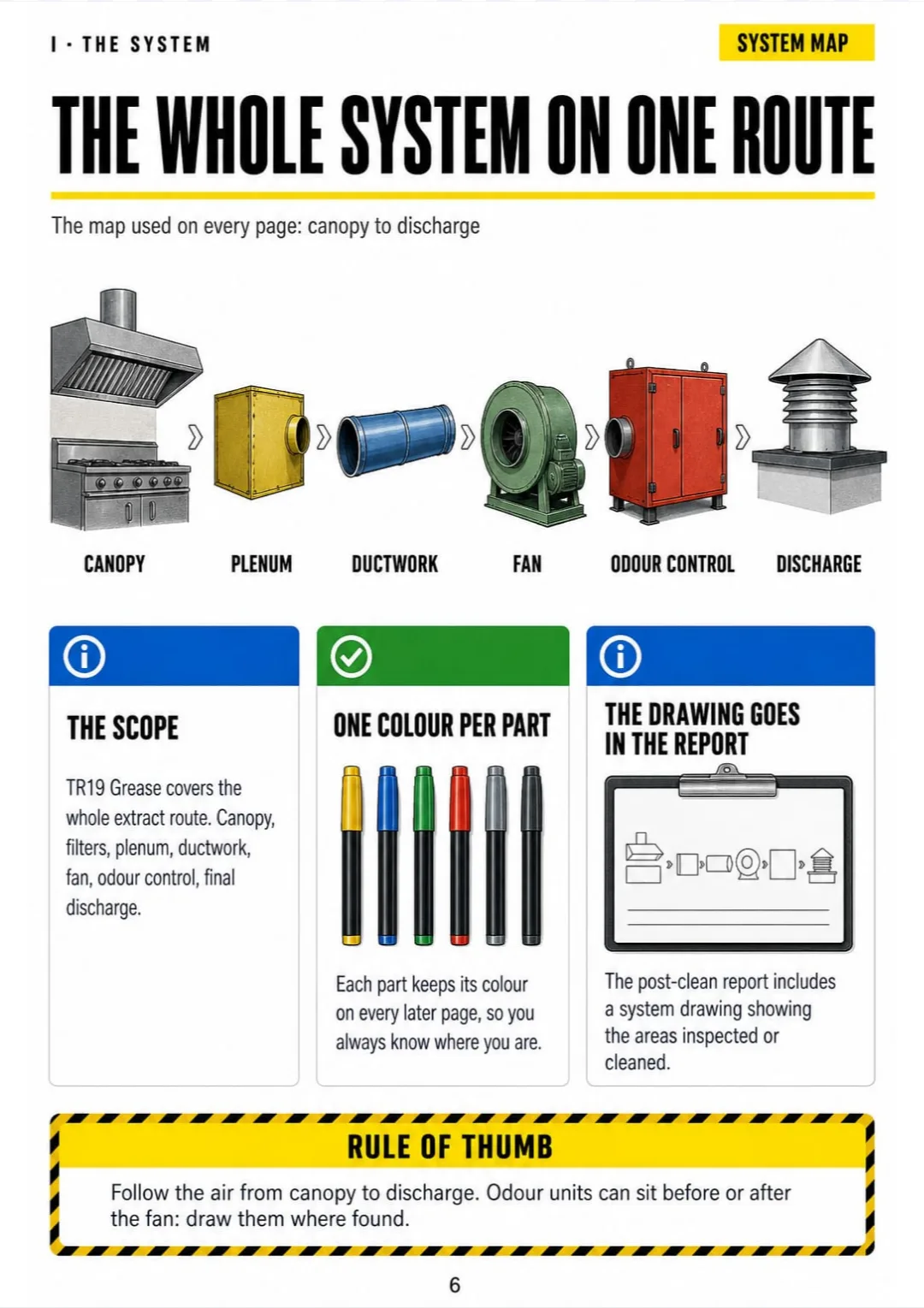
Canopy → filters → plenum → duct → fan → odour unit → discharge, all in scope
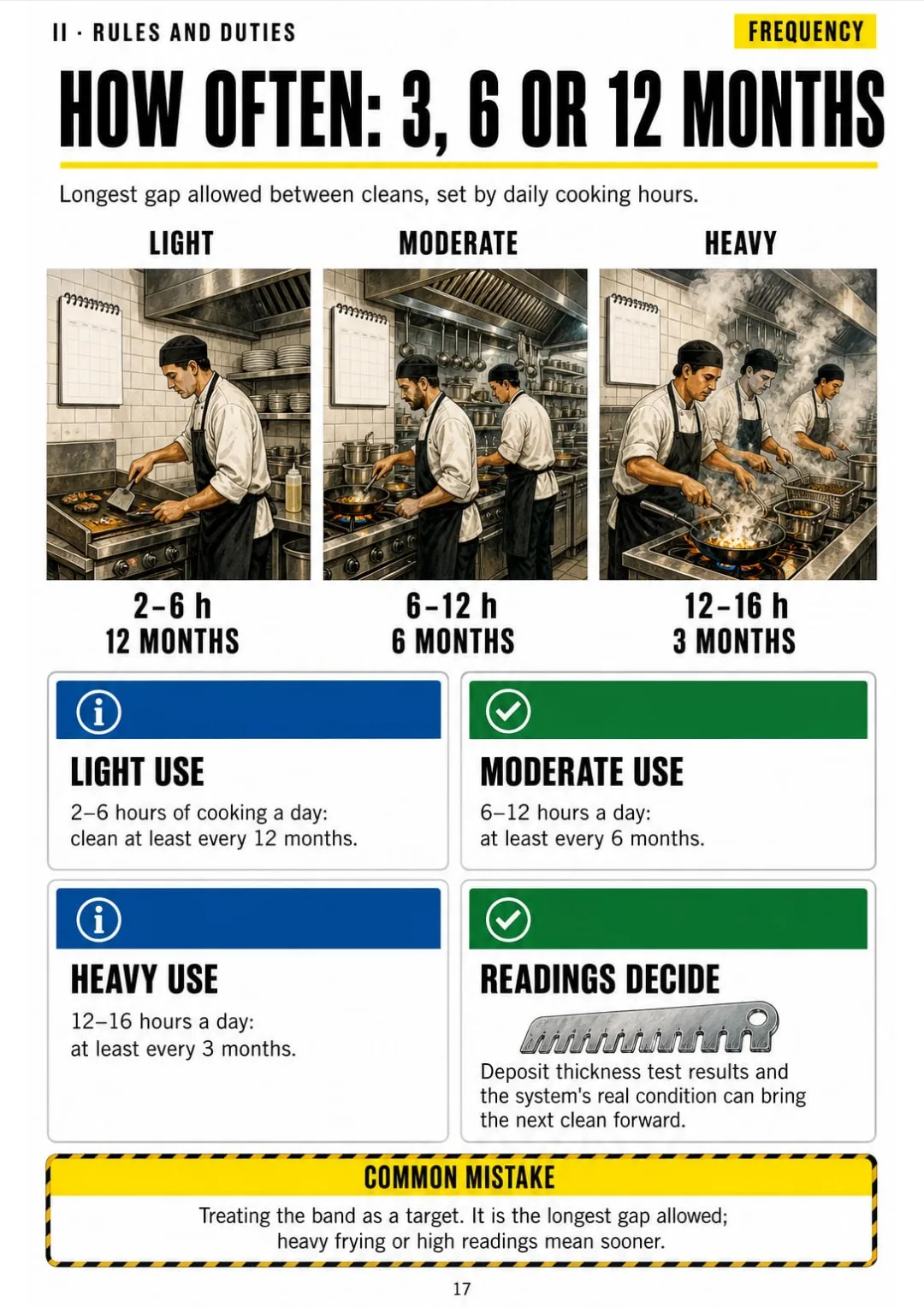
Heavy 12–16 h: 3 months · Moderate 6–12 h: 6 months · Light 2–6 h: 12 months.
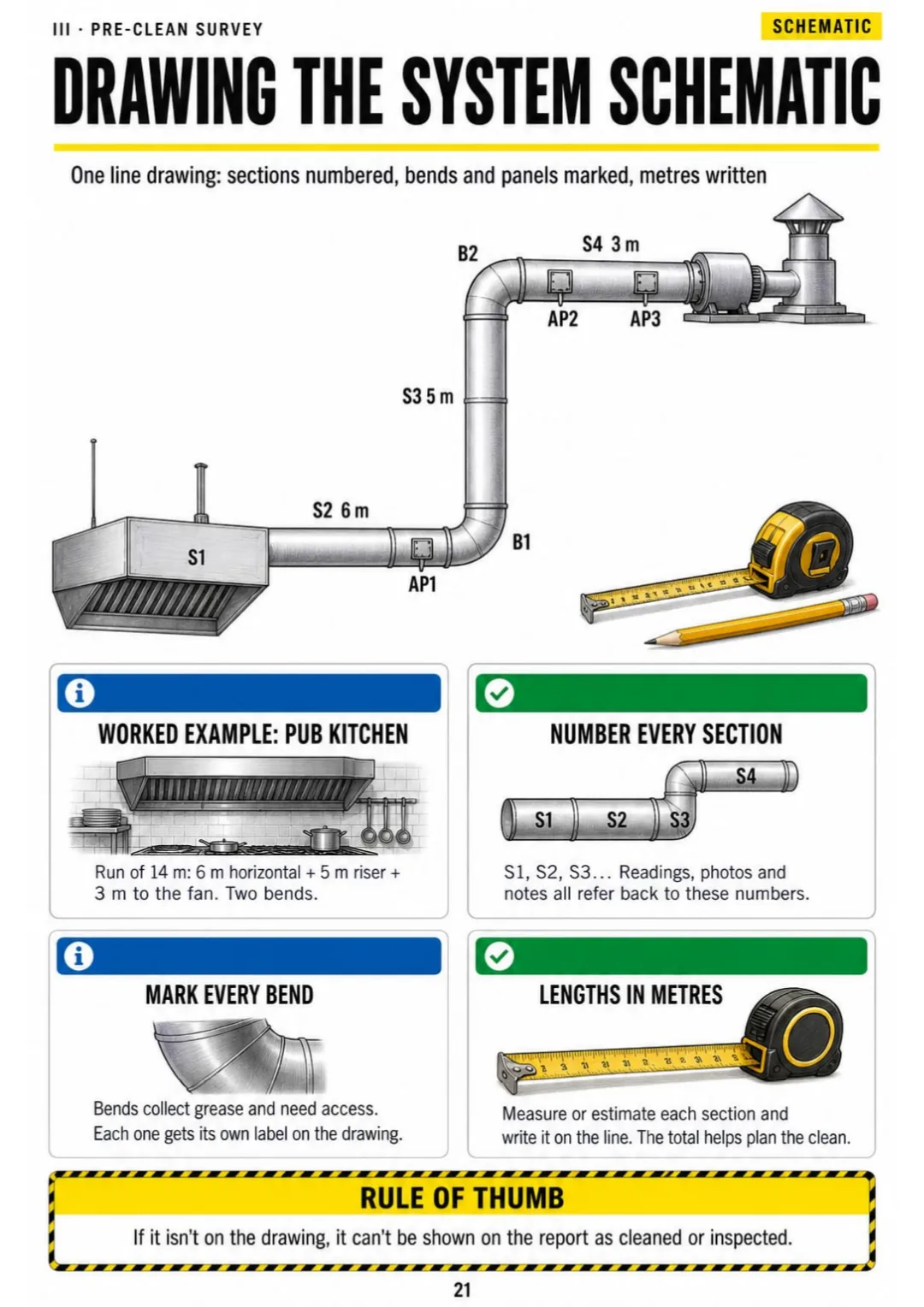
Worked example: a pub kitchen, 14 m run, two bends, every section numbered.
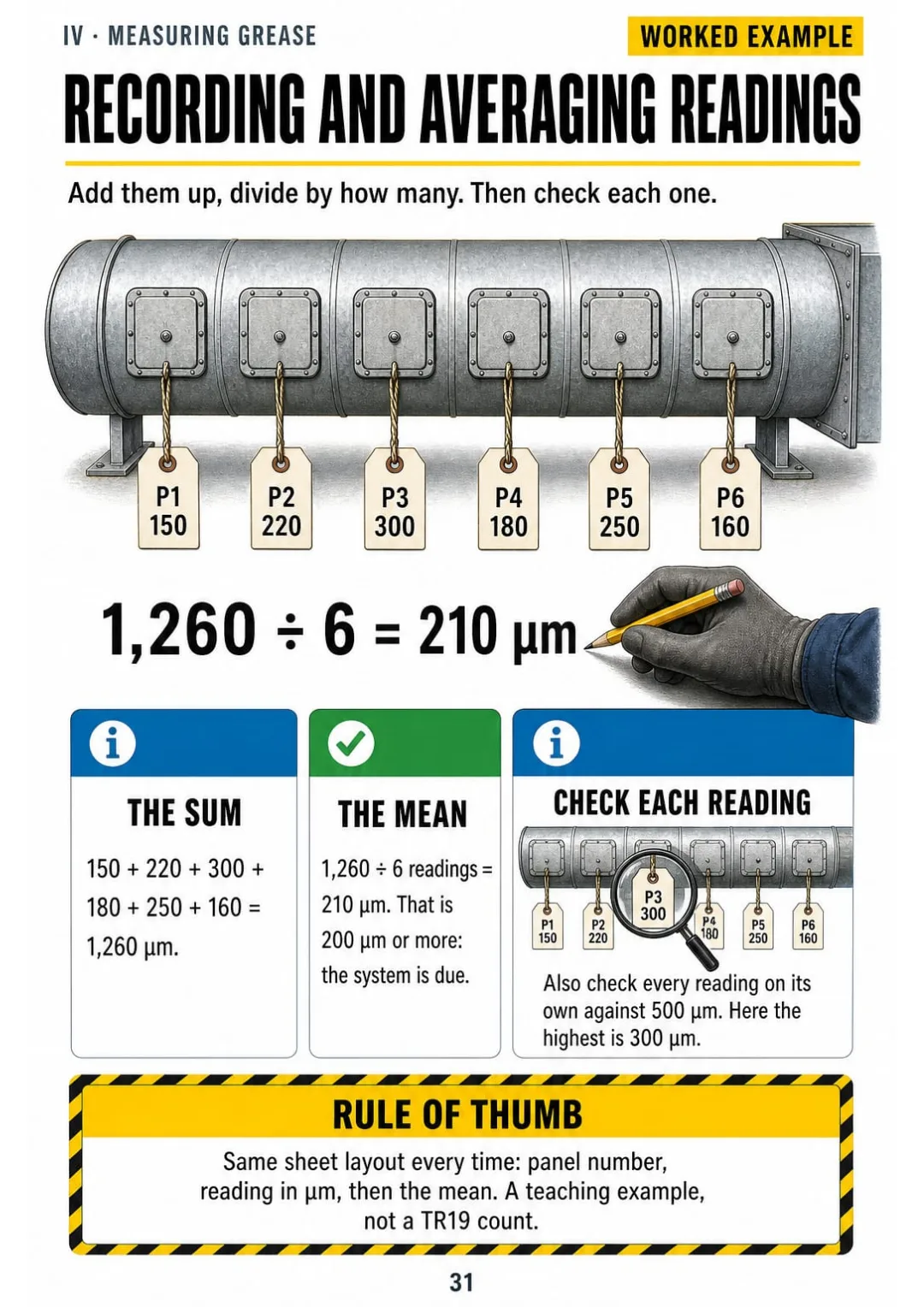
150 + 220 + 300 + 180 + 250 + 160 = 1,260 µm ÷ 6 = 210 µm
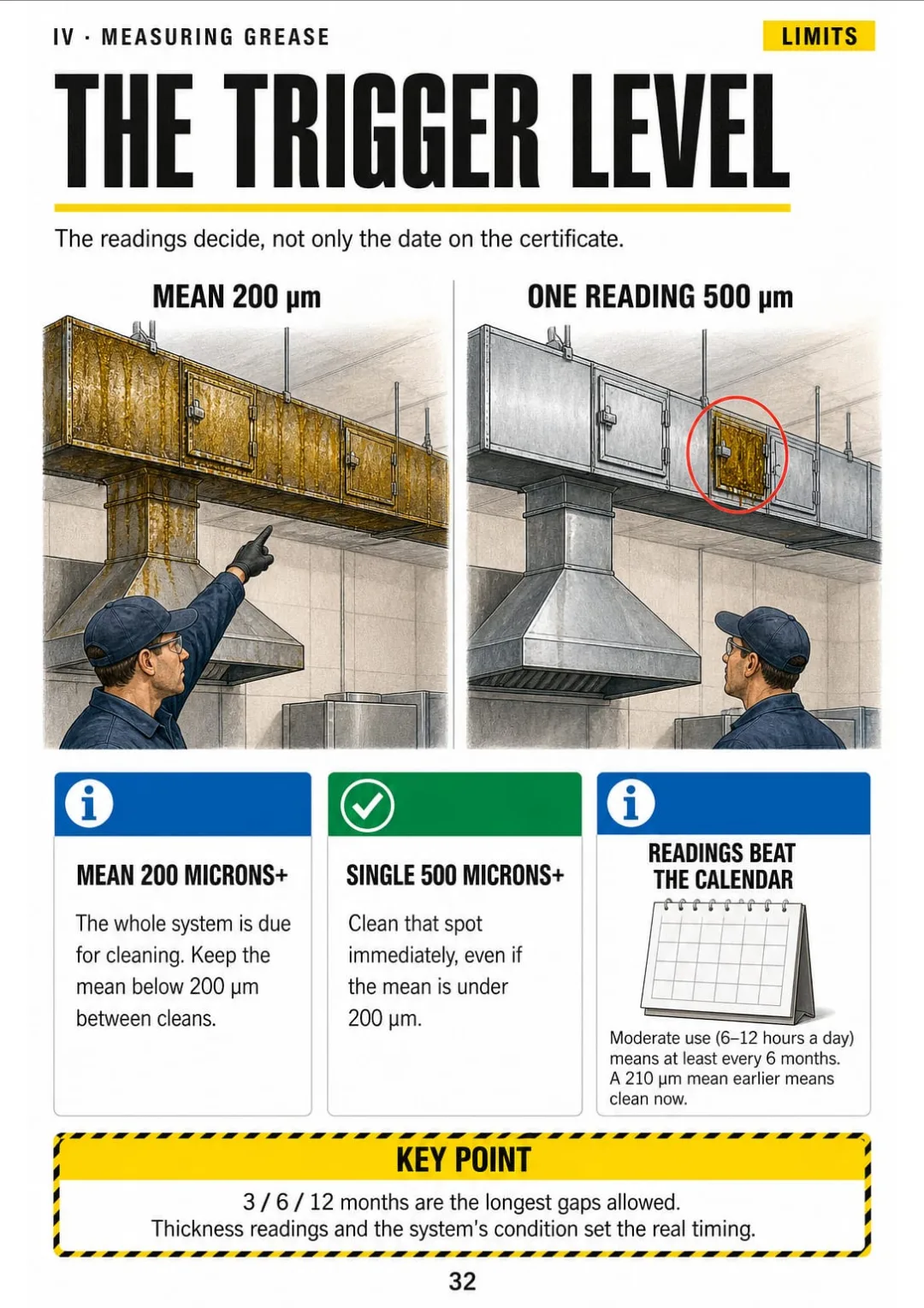
Mean 200 µm or more: clean the system · single 500 µm: clean that spot now
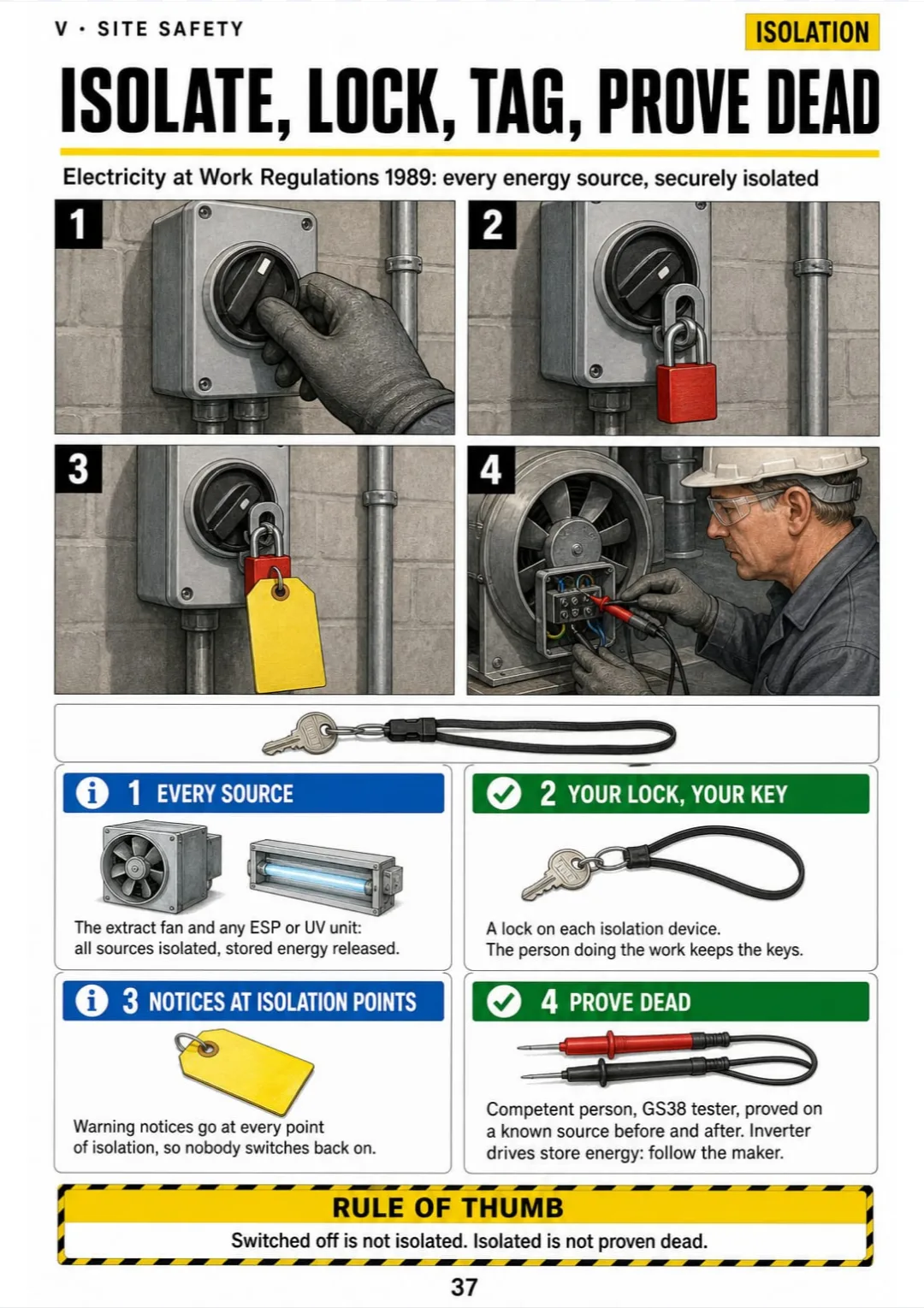
Lock-off in 4 steps under the Electricity at Work Regulations 1989, plus the key rule.
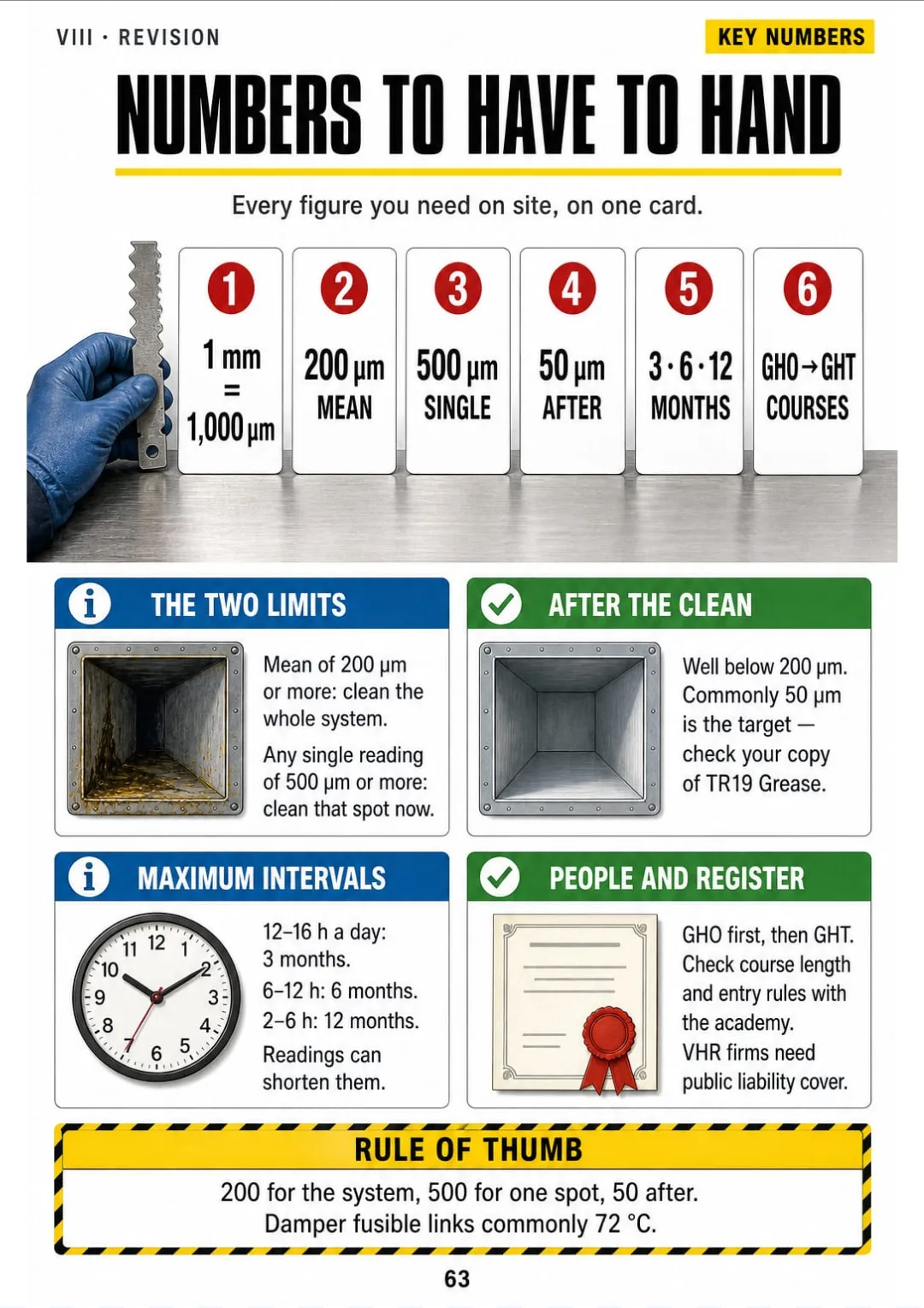
200 µm mean = clean · 500 µm single = clean now · 3/6/12 months by hours of use.
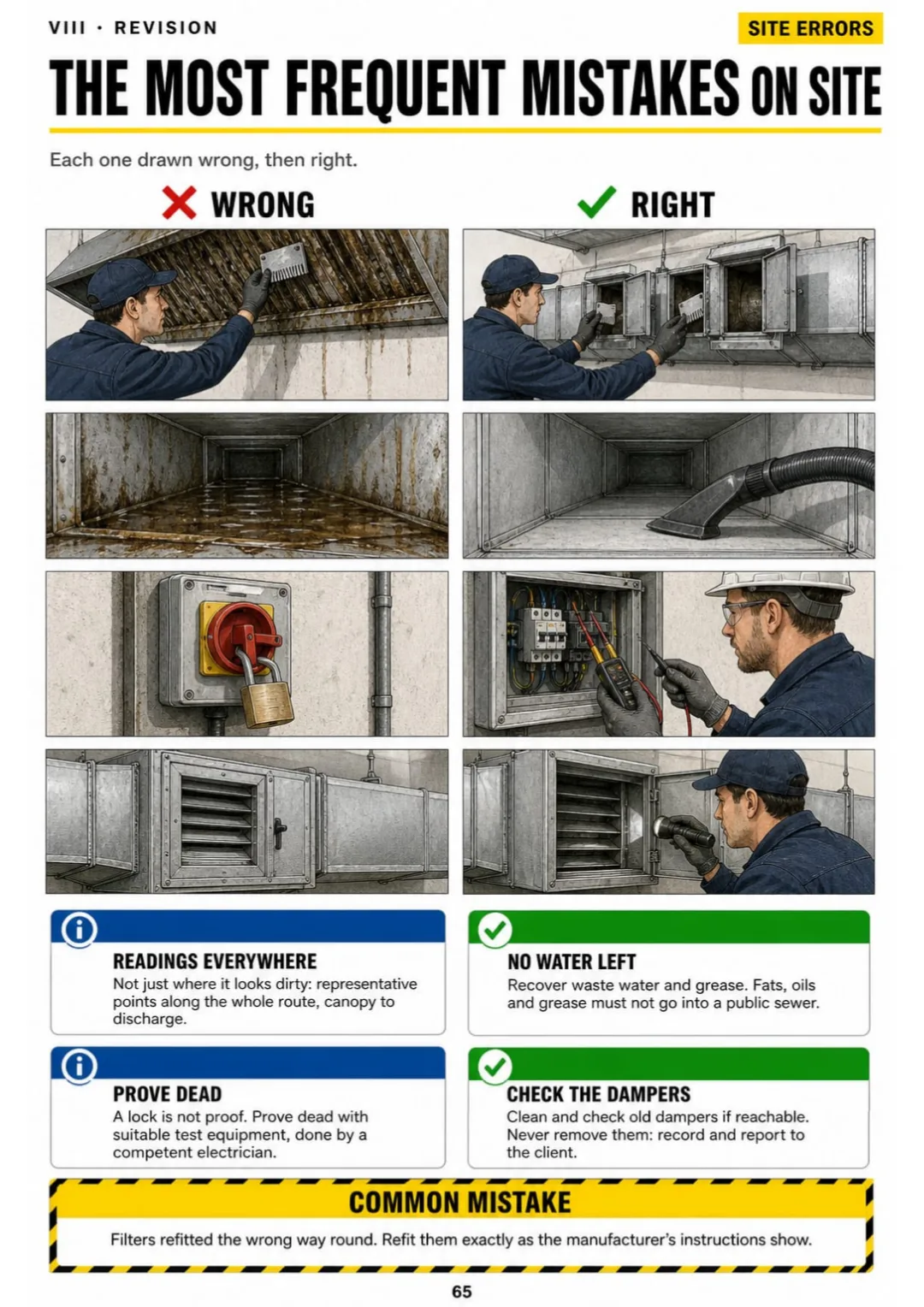
Readings, water, isolation, dampers and filters: the site mistakes and their fix.

Swipe to see more →

These are real pages from the book. The table of contents is the full one: 8 parts and 63 topics.

The Problem Isn't You. It's How It Was Explained to You.

You're standing in a pub kitchen with a clipboard. The survey needs a schematic of the whole extract run, and you're looking up at a ceiling void, wondering where to start.

You've done the cleaning for years. But the guidance describes the schematic in paragraphs: sections, access points, bends, what to label. On site, with the ceiling tile up, none of those paragraphs tells you where to start.

Worked example: a pub kitchen, 14 m run, two bends, every section numbered.

In the book, that same schematic is one page: a pub kitchen, a 14 m run, two bends, every section numbered and drawn from canopy to discharge.

The same goes for comb gauge readings, the trigger level, lock-off in four steps, cleaning frequency and the post-clean report: each one has its own page.

So you draw the schematic on site, number every section and get on with the job without going back to the guidance.

COMPARE FOR YOURSELF

The Same Topic, Two Ways to Study It

THIS
  • The guidance: line after line
  • Cleaning intervals explained only in words
  • You arrive at the course still unsure
The frequency at which the internal surfaces of a kitchen extract system should be cleaned is generally determined by reference to the anticipated duration of cooking operations per day, in conjunction with the nature of the cooking undertaken and the consequent rate of grease accumulation. Systems subject to heavy use, typically in the region of twelve to sixteen hours daily, may require attention at intervals of approximately three months, whereas moderate and light usage permit progressively extended intervals, subject always to the findings of deposit thickness measurement.
FOR THIS
  • Cleaning frequency in one drawing
  • The 3, 6 and 12 months in a box
  • You see it and you get it
Heavy 12–16 h: 3 months · Moderate 6–12 h: 6 months · Light 2–6 h: 12 months.
CONTENTS

Take a Look at the 8 Parts and 63 Topics

The system, rules and frequencies, the pre-clean survey, measuring grease, safe isolation, cleaning methods, inspection and certification, and final revision: 67 pages, all illustrated.

IThe System, Canopy to Discharge · pp. 5-13
  1. Why grease in a duct is a fire waiting to happen
  2. One route: the whole system on one drawing
  3. The canopy and the plenum behind the filters
  4. Grease filters: baffle versus mesh
  5. Ductwork: horizontal runs, bends and risers
  6. The extract fan: centrifugal, axial and in-line
  7. Fire dampers and fire-rated ductwork
  8. Odour control: carbon filters, ESP and UV units
  9. Discharge and make-up air
IIRules, Duties and Frequencies · pp. 14-19
  1. Who is legally responsible for the duct
  2. What the TR19 Grease guidance covers and what it doesn't
  3. Why the insurer asks for the certificate
  4. How often: cleaning frequency by hours of cooking a day
  5. Kitchen staff jobs versus contractor jobs
  6. The operative, the supervisor and the register
IIIThe Pre-Clean Survey · pp. 20-27
  1. The survey in 8 checks, always in the same order
  2. Drawing the system schematic
  3. Finding and counting the access panels
  4. Where access panels should be
  5. Inaccessible sections: spot them and say so
  6. Don't break the fire stopping
  7. Site hazards seen on survey
  8. From survey to time on site
IVMeasuring Grease: the Comb Gauge · pp. 28-34
  1. Microns: the only unit you need
  2. The Deposit Thickness Test, step by step
  3. Where to take the readings
  4. Recording and averaging readings: worked example
  5. The trigger level: when a system needs cleaning
  6. The post-clean target
  7. When you can't use the gauge
VSafe Isolation and Site Safety · pp. 35-43
  1. RAMS: risk assessment and method statement
  2. Permit to work and the kitchen manager's sign-off
  3. Electrical isolation and lock-off
  4. Gas appliances: your limit
  5. Working at height
  6. Confined spaces
  7. Degreasers and COSHH
  8. Protecting the kitchen
  9. Waste water and grease disposal
VICleaning Methods · pp. 44-53
  1. Choosing the method by deposit type
  2. Manual scraping
  3. Chemical degreasing and dwell time
  4. Hot water, steam and pressure washing
  5. Rotary brushing
  6. Dry ice blasting
  7. Canopy, plenum and filter housing
  8. Cleaning the fan
  9. Risers and long vertical runs
  10. Fire dampers: clean, check and record
VIIInspect, Photograph, Report, Certify · pp. 54-61
  1. The post-clean inspection
  2. Before and after photos that prove the job
  3. What goes on the post-clean report
  4. Declaring what was not cleaned
  5. Writing recommendations the client can act on
  6. The certificate and the next due date
  7. Handover to the kitchen manager
  8. Keeping records
VIIIRevision and Final Checks · pp. 62-67
  1. The whole job on one page
  2. Numbers to have to hand
  3. UK laws in one drawing
  4. The most frequent mistakes on site
  5. The most frequent mistakes on paper
  6. Before the course: your self-check

One Page, One Topic, All Clear

Think of it this way:

You've just taken six comb gauge readings along a hotel kitchen duct. The kitchen manager wants to know if it needs cleaning today.

You open the book at the trigger level page and see it drawn: a mean of 200 µm or more, clean the system; a single 500 µm reading, clean that spot now.

Mean 200 µm or more: clean the system · single 500 µm: clean that spot now

Same with the survey schematic, access panels, lock-off, dry ice blasting and the post-clean certificate: each one on its own page.

Kitchen Extract Cleaning Illustrated is 8 parts and 63 topics, all drawn, ending with the numbers to have to hand, the most frequent mistakes and a self-check before the course.

What you see drawn, you don't have to memorize.

What's Inside Kitchen Extract Cleaning Illustrated:

Ipp. 5-13

The System, Canopy to Discharge

Why grease in a duct is a fire risk, the whole route on one drawing, canopy and plenum, baffle and mesh filters, ductwork, fans, fire dampers, odour control and discharge.

IIpp. 14-19

Rules, Duties and Frequencies

Who is responsible for the duct, what the guidance covers, why the insurer wants the certificate, cleaning frequency by hours of cooking and who does which job.

IIIpp. 20-27

The Pre-Clean Survey

The survey in 8 checks, the system schematic, finding and placing access panels, inaccessible sections, fire stopping, site hazards and time on site.

IVpp. 28-34

Measuring Grease: the Comb Gauge

Microns, the deposit thickness test step by step, where to take readings, averaging them, the trigger level, the post-clean target and when the gauge can't be used.

Vpp. 35-43

Safe Isolation and Site Safety

RAMS, permit to work, electrical isolation and lock-off, gas appliances, working at height, confined spaces, degreasers and COSHH, protecting the kitchen and waste disposal.

VIpp. 44-53

Cleaning Methods

Choosing the method, scraping, chemical degreasing, hot water and steam, rotary brushing, dry ice, canopy and plenum, the fan, risers and fire dampers.

VIIpp. 54-61

Inspect, Photograph, Report, Certify

The post-clean inspection, before and after photos, the report, declaring what wasn't cleaned, recommendations, the certificate, handover and records.

VIIIpp. 62-67

Revision and Final Checks

The whole job on one page, the numbers to have to hand, UK laws in one drawing, the most frequent mistakes on site and on paper, and your self-check.

At the end of the book: The whole job on one page, the numbers to have to hand and a pre-course self-check.
Plus: 2 Free Books

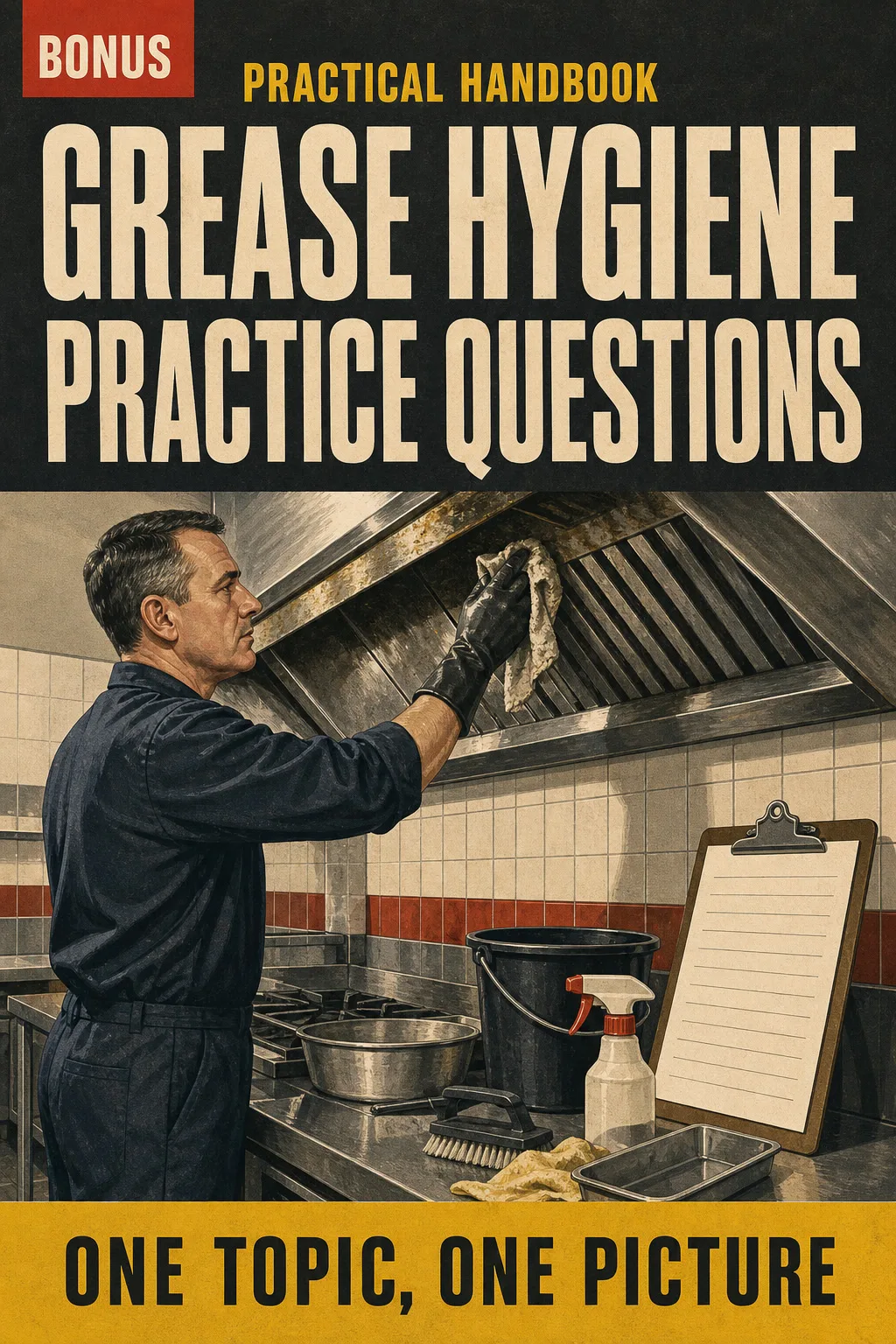
Grease Hygiene Practice Questions

BONUS 1: «Grease Hygiene Practice Questions»

Value on its own: US$ 17.90

Exam-style questions with worked answers, so you can check what you really know before the course instead of finding out on the day.

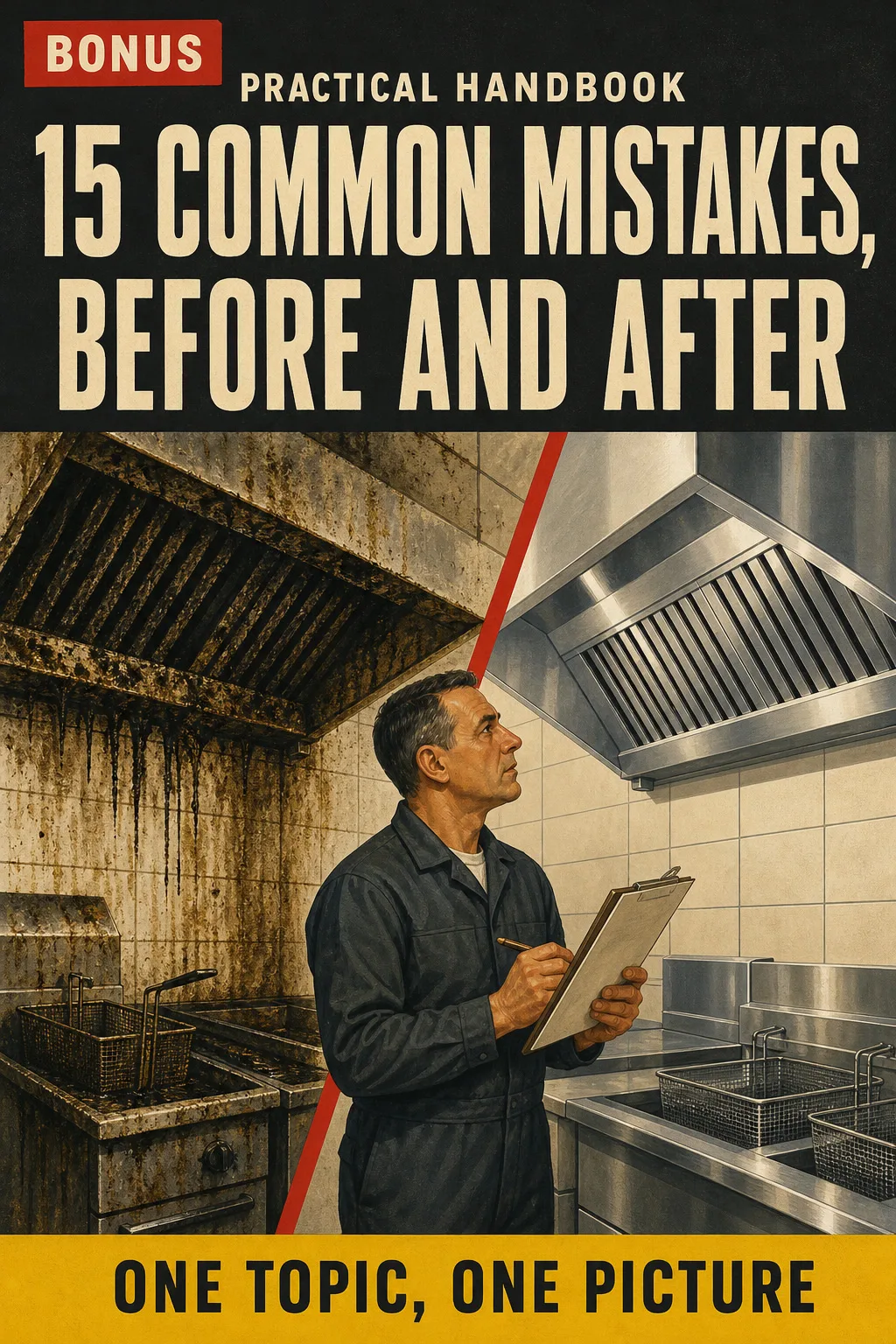
15 Common Mistakes, Before and After

BONUS 2: «15 Common Mistakes, Before and After»

Value on its own: US$ 14.90

The most frequent errors on site and on paper, each drawn wrong and then right, to revise at a glance in the van.

Kitchen Extract Cleaning Illustrated with 2 Free Books

  • Kitchen Extract Cleaning Illustrated: 67 illustrated pagesUS$ 63
  • BONUS 1: Grease Hygiene Practice QuestionsUS$ 17.90
  • BONUS 2: 15 Common Mistakes, Before and AfterUS$ 14.90
  • High-resolution PDF to printIncluded
Total value US$ 95.80
YOUR PRICE:
US$ 27
You save US$ 68.80
YES, I WANT KITCHEN EXTRACT CLEANING ILLUSTRATED FOR US$ 27

📄 This is a digital PDF book sent to your email: nothing is printed or shipped.

Secure purchaseEncrypted payment30-day guarantee

PDF by email: We email you Kitchen Extract Cleaning Illustrated as a PDF, together with the two free books. It's a single payment: no installments, no extra charges.

Who This Book Is For

You're preparing for the grease hygiene course

You're preparing for the grease hygiene course

The whole system and the guidance in drawings, one topic per page, so you study it in the same order as the job.

The course date is close

The course date is close

The numbers to have to hand, the most frequent mistakes and a self-check, to revise at a glance in the van the week before.

You already clean ducts for a living

You already clean ducts for a living

A fixed sequence from survey to certificate, so the readings, the report and the next due date are right on every job.

Everything You Get Today

US$ 95.80US$ 27
YES, I WANT KITCHEN EXTRACT CLEANING ILLUSTRATED FOR US$ 27

📄 This is a digital PDF book sent to your email: nothing is printed or shipped.

30DAYS
GUARANTEE

30-Day Guarantee

Try Kitchen Extract Cleaning Illustrated for 30 days, bonus books included.

We refund everything if the file won't open, if the book isn't what you see here, if you were charged twice or if the email doesn't arrive. Just email us.

You pay once. No subscriptions.

Frequently Asked Questions

Is it for me if I've been cleaning ducts for years?

Yes. It doesn't teach you to scrape a duct. It puts the guidance, the numbers and the paperwork in one fixed order, with a drawing per topic, so you can revise what the course and the client ask for.

Where does the content come from?

It's written for the UK, not adapted from another country. It follows the TR19 Grease guidance used here, with UK units (microns, metres), read together with HSE guidance and UK law: Electricity at Work Regulations 1989, Work at Height Regulations 2005, COSHH 2002 and Confined Spaces Regulations 1997.

Is it official material?

No. It's an independent illustrated study book. It isn't published, approved or endorsed by the guide's publisher, any training academy or the HSE.

Does it replace the course?

No. It helps you understand and revise, but it doesn't replace the accredited course, supervised work on site or your employer's procedures. It doesn't give you a certificate or a card, it doesn't put you on any register, and it doesn't guarantee a pass. It's what you study with before and after the course.

Are the practice questions the ones from the course exam?

No. They're written for this book to help you check what you know. They aren't official questions from any course or exam.

When and how do I get it?

The book and the 2 bonus books come as PDFs by email.

Do I have to pay every month?

No. It's a one-off payment. No subscription.

Can I have it on paper?

Yes. It's a printable PDF: print it at home or at a print shop and keep it in the van.

How does the refund work?

You have 30 days. We refund everything if the file won't open, if the book isn't what you see on this page, if you were charged twice or if the email doesn't arrive: just email us.

Before You Close This Page

No more rereading without anything sticking.

Comb gauge readings, drawn so they make sense first time.

You arrive at the course knowing where everything is.

Drawings make studying faster.

The book is right below.

One-time payment: US$ 27 · Guarantee: 30 days · PDF by email

YES, I WANT KITCHEN EXTRACT CLEANING ILLUSTRATED FOR US$ 27

📄 This is a digital PDF book sent to your email: nothing is printed or shipped.